
'The strategy has to be restoring order in one part and countering the very effective propaganda through a very nimble monitoring and response system,' says Lieutenant General Syed Ata Hasnain, who retired as the General Officer Commanding of the Srinagar-based 15 Corps.

If the initial analysis of this YJ-21 is correct, then China becomes the first country in the world to operationally field such a missile from a naval vessel.

'India has ramped up infrastructure on its side, so the Chinese military is finding Indian soldiers in locations where they are not used to seeing an Indian footprint,' points out Harsh V Pant.
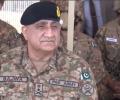
'The picture only looks worse from where Bajwa sits.' 'He sees a domineering India to the east, an unravelling Afghanistan and a complex Iran to the west, an overbearing China on the north and a US which is no longer an ally,' observes Shekhar Gupta.

'Even as discord over US-India trade and commerce colours diplomatic relations, defence relations between the two countries remain on a firm footing,' points out Ajai Shukla.

Lieutenant General Syed Ata Hasnain (retd), former general officer in commanding, 15 Corps, explains what may have happened during the Indian Army's anti-terrorist operation in Kashmir in which four soldiers and one policemen, including the commanding officer 21 Rashtriya Rifles, made the supreme sacrifice for the Motherland.
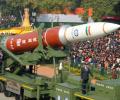
'The government must provide more funds to enable the armed forces to fight and win tomorrow's wars,' states Brigadier Gurmeet Kanwal (retd).

'Many misunderstood non-violent satyagraha as a passive strategy; it was anything but that,' notes Colonel Anil A Athale (retd).

The Indian Army has been matching up to the Chinese build up in both Pangong Tso lake and Galwan Valley, the two locations in Ladakh which have witnessed major reinforcement of troops in the last two weeks, sources said. There was very little chance of easing of tension anytime soon as both sides are aggressively holding onto their respective positions, they said.
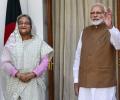
'If the Bangladesh-China relationship strengthens further, it can only be to India's detriment,' notes Vice Admiral Premvir Das.

US admiral's suggestion for a revival of a strategic maritime quadrilateral with Japan, Australia and India leaves China livid, says Rajeev Sharma.

Brigadier M P Bajwa (retd), commander of the troops that captured Tiger Hill, tells Rediff.com's Archana Masih how a band of young soldiers won the Kargil War's most famous battle with their blood and grit.

The recent breach of ceasefire by Pakistan was aimed at infiltrating Lashkar-e-Tayiba cadres into Jammu and Kashmir ahead of the polls and to bring Kashmir issue back into limelight, as the neighbouring country was feeling isolated with the growing clout of India in the international forum, according to security experts.

Pepsi is betting on Dabangg 3's box office success.
Indian military sources said no firearms were used in the clashes and that most of the injuries were sustained following stone-pelting and use of rods by the Chinese side.
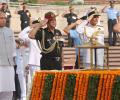
Ajai Shukla presents an action plan for Defence Minister Rajnath Singh to fix the systemic weaknesses in defence.

Excerpts from Prime Minister Narendra Modi's speech at the Combined Commanders Conference on board the INS Vikramaditya at sea, off the coast of Kochi.

From Sri Lanka's most popular political family to its most despised -- going by the voices on the streets calling for the Rajapaksas' ouster -- what went wrong for the clan? Veteran Sri Lanka watcher N Sathiya Moorthy offers an insight.

Prime Minister Modi felt there were too many silos with no arrangement to take a comprehensive view on national security. The PM has entrusted NSA Ajit Doval to evolve a comprehensive roadmap and get it implemented, reveals Nitin Gokhale, Editor-in-Chief, Strategic News International.
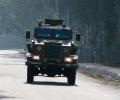
'The devious minds across the border will test us to the hilt, but in the course of that will offer us opportunities for which we must be prepared,' says Lieutenant General Syed Ata Hasnain (retd), who commanded the Uri Brigade, the Baramulla Division and the Srinagar-based Chinar Corps.

'Cooperation at sea involves not just ships going out together and carrying out exercises over a couple of days, but understanding the whys and the wherefores,' points out Vice Admiral Premvir Das (retd).

Rediff.com present a comprehensive listing of the nuclear nations and their collective and active stockpile.

'We rarely choose to fight when the threat is still a nascent threat. When we do fight, we fight when the invaders reach Panipat and are preparing to knock on the gates of Delhi.'

Admiral Sam Locklear heads the US Pacific Command, making him the most powerful military commander on earth. With 60 per cent of the US Navy under him, PACOM oversees 52 per cent of the planet. Locklear is America's military pointsman for 36 countries, including India and China.

'If only Cariappa/Thimayya/Chaudhari/Manekshaw were given a free hand, there'll be no PoK, the Chinese would have been taught a lesson, 1965 would have slain the Pak demon and in 1971 just another fortnight's fighting after Bangladesh and West Pakistan would have been occupied.' 'No authoritative military account suggests anything remotely like any of these...' '...Chronologies, names, even periods get mixed up, but, never mind, because the point -- strong Army denied by cowardly Congress -- is made.' 'This is where Modi is coming from,' points out Shekhar Gupta.

On his first day in office, Army Chief Gen Dalbir Singh Suhag on Friday warned Pakistan that India's response to any beheading-like incident in future would be "more than adequate, intense and immediate".
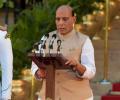
The new minister must commit himself to supporting long-term defence plans or else defence modernisation will continue to lag and the growing military capabilities gap with China will assume ominous proportions, warns Brigadier Gurmeet Kanwal (retd).

What India has failed to acknowledge is that sub-conventional war is the name of the game and irregular forces have emerged with greater strategic value over conventional and even nuclear forces, and reliance purely on conventional force and diplomacy is grossly inadequate, says Lt Gen Prakash Katoch (retired).

Thirty-four years after he traveled to space, Wing Commander Rakesh Sharma tells Rediff.com's Archana Masih that he looks forward to Gaganyan, India's first manned space mission in 2022.

'A veiled secret of India's defence and strategic culture is the lack of a serious interest in them by the political class. The Indian National Defence University would fill this void,' feels Lieutenant General Anil Chait (retd).

The strategy, President Donald Trump said, is tailored and flexible to address the wide array of threats in the 21st century.
'India appears to have stood its ground on strategic autonomy by resisting US pressure on Russia, China and Iran, but succumbed to the temptation to walk into a tighter embrace in defence cooperation, a high priority of the Trump administration,' notes Ambassador T P Sreenivasan.
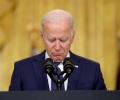
Afghanistan will remain a frontline state for Washington for a foreseeable future in terms of the potential threats to US national security from terrorist groups, asserts Ambassador M K Bhadrakumar, who played a stellar role in beginning India's dealings in Afghanistan in 1994.

Narrowing of differences on competing territorial claims along the un-demarcated LAC might take weeks, if not months, of hard-nosed negotiations. Without some give and take on both sides, the impasse will be hard to resolve, observes Virendra Kapoor.

The parade began after President Ram Nath Kovind conferred the Ashoka Chakra -- India's highest peacetime gallantry award -- to Lance Naik Nazir Ahmad Wani, a militant-turned-soldier who laid down his life fighting a group of terrorists in Shopian in Kashmir in November.
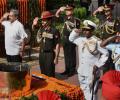
Amongst those who heard the message of the Bihar results would be Defence Minister Manohar Parrikar, whose realm is simultaneously the country's most complex and -- when something goes wrong -- the most emotive, says Ajai Shukla.

The election seem to have been conducted without any major security lapses. However, in the coming weeks, the military situation in Kandahar could tilt in the Taliban's favour, notes Aveek Sen.
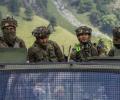
'A breakthrough in eastern Ladakh leading to disengagement and creation of a buffer zone will obviate the need of military deployment through the winter months ahead,' notes Ambassador M K Bhadrakumar.
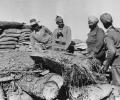
'The Himmatsinghji Report is still 'missing'.' 'It is a great loss for the knowledge of India's borders.' 'It would have an immense value at a time China is bound to shift its attention to other border fronts in the Himalayas,' notes Claude Arpi.

By jettisoning the seniority principle, the government has sent a strong signal that only merit and suitability will count in occupying posts in the higher echelons of the military, writes national security expert Nitin Gokhale.
